Frequently Asked Questions
The most-asked questions about conifers and gymnosperms.
What exactly are gymnosperms?
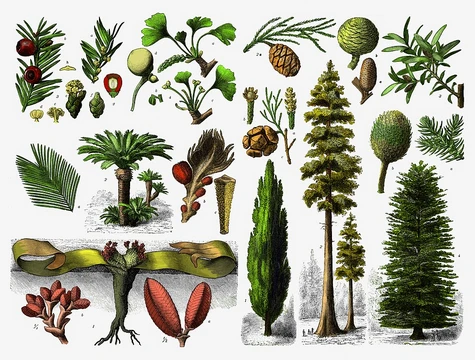
Gymnosperms are seed-producing plants whose seeds develop exposed on the surface of scales or leaves rather than enclosed inside an ovary. The name literally means 'naked seed' in Greek. The group encompasses conifers, cycads, ginkgo, and gnetophytes.
How are conifers different from gymnosperms?
Conifers (order Pinales) are one subgroup within the larger gymnosperm clade. Every conifer is a gymnosperm, but gymnosperms also include cycads, Ginkgo, and gnetophytes, none of which are conifers.
Which families should a newcomer learn first?
The most widely recognized conifer families are Pinaceae (pines, firs, spruces, larches), Cupressaceae (cypresses, redwoods, junipers), Araucariaceae, and Taxaceae (yews). Beyond conifers, Ginkgoaceae, Cycadaceae, and Gnetaceae complete the gymnosperm picture.
What's the most iconic species to start with?
For conifers, the Norway spruce (Picea abies) or Scots pine (Pinus sylvestris) are natural entry points given their ubiquity in forestry and holiday traditions. For the wider gymnosperm world, Ginkgo biloba is the most instantly recognizable 'living fossil.'
How do gymnosperms reproduce without flowers or fruit?
Gymnosperms rely on wind-pollinated cones (or cone-like structures) in which pollen grains land directly on the exposed ovule and fertilization occurs without a closed ovary. The mature seed then sits naked on a scale or bract rather than being packaged inside a fruit.
How long have gymnosperms been around?
Fossil evidence places the earliest gymnosperm-like plants in the late Carboniferous, around 300 million years ago. Conifers in particular have a continuous lineage stretching back to that era, making them among the oldest surviving vascular plant groups.
How many species are there in total?
There are roughly 1,000 conifer species spread across about 230 genera. Adding cycads, ginkgo, and the gnetophytes brings the total gymnosperm count to approximately 1,000–1,200 species.
Where do gymnosperms grow around the world?
Conifers dominate the boreal belt across the Northern Hemisphere and also colonize mountain ranges from the Andes to East Asia. Cycads and gnetophytes are largely confined to tropical and subtropical regions, while Ginkgo is native to a small stretch of central China.
What's the biggest 'milestone' in gymnosperm evolutionary history?
The Permian–Triassic mass extinction (~252 Ma) eliminated many competing seed-plant groups, after which conifers and their relatives radiated to dominate terrestrial ecosystems for roughly the next 150 million years. That unchallenged reign is often called the 'Age of Conifers.'
Are all gymnosperms trees?
Most conifers are trees or large shrubs, but the gymnosperm group as a whole includes low, ground-hugging perennials like Welwitschia mirabilis, which grows just two evergreen leaves for its entire life. Several cycads are small, palm-like plants that could easily be mistaken for tropical ornamentals.