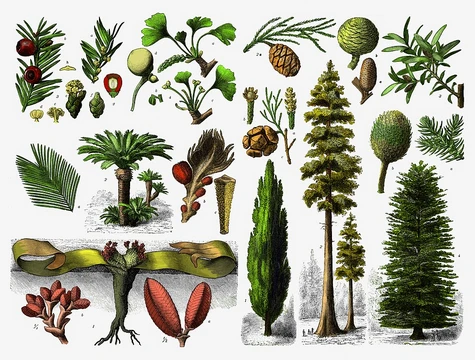
Taxus brevifolia
Slow-growing conifer valued for medicine and traditional tools.

Taxus brevifolia, commonly known as the Pacific yew or western yew, is a species of tree in the yew family Taxaceae native to the Pacific Northwest of North America. It is a small evergreen conifer that thrives in moisture and often takes the form of a shrub. The tree is extremely slow-growing, with a habit of rotting from the inside, making accurate age determination difficult.
- field
- Botany
- native_range
- Pacific Northwest of North America (southern Alaska to Northern California, with disjunct populations in southeast British Columbia and Northern Idaho)
- known_for
- Source of the chemotherapy drug paclitaxel (taxol); traditional use by Native Americans for tools, bows, and medicine
- height
- 10–15 meters (33–49 feet), rarely over 20 m (66 ft)
- trunk_diameter
- Up to 50 cm (20 inches), rarely more
Lore & Background
Taxus brevifolia is a small evergreen conifer that sometimes appears as a shrub, growing 10–15 meters tall with a trunk up to 50 cm in diameter. It is extremely slow-growing and often rots from the inside, creating hollow forms that make ring counts unreliable. The tree has thin, scaly bark that is red then purplish-brown, covering off-white sapwood and darker heartwood that varies from brown to purplish to deep red or bright orange when freshly cut. Its leaves are lanceolate, flat, dark green, and arranged spirally on the stem but twisted to lie in two flat rows. The seed cones are highly modified, each containing a single seed partly surrounded by a soft, bright red berry-like aril that is eaten by thrushes and other birds, which disperse the seeds. The male cones are globose and shed pollen in early spring. The species is mostly dioecious, but occasional individuals can be variably monoecious or change sex with time.
Reader's Guide
Taxus brevifolia holds significance both ecologically and historically. Ecologically, it provides food for birds (thrushes) and moose, and its shade tolerance allows it to form an understory along streams, helping maintain water temperature. Historically, Native Americans used its resilient, rot-resistant wood for tools, bows, arrows, canoe paddles, harpoons, fishhooks, wedges, clubs, spoons, drums, snowshoes, and arrowheads, and used the foliage and bark for medicinal purposes. The tree gained modern importance as the original source of the chemotherapy drug paclitaxel (taxol), used in breast, ovarian, and lung cancer treatment. The tree also has two recognized varieties: var. reptaneta (thicket yew), a creeping shrub form that forms thickets, and var. polychaeta (worm cone yew), which produces multiple secondary shoots on its seed cones. Both varieties have been disputed as synonymous with the typical variety, and the worm cone yew may have been extirpated from its type locality near Olympia, Washington, due to urban expansion.
Did You Know?
- The Pacific yew is extremely slow-growing and often rots from the inside, making accurate ring counts difficult.
- The seed cones produce a soft, bright red berry-like aril that is eaten by thrushes and other birds, which disperse the hard seeds undamaged.
- The variety Taxus brevifolia var. polychaeta (worm cone yew) may have been extirpated from its type locality near Mud Bay near Olympia, Washington, due to urban expansion.
Frequently Asked Questions
What is Taxus brevifolia?
Taxus brevifolia is a small evergreen conifer in the yew family (Taxaceae), commonly called the Pacific yew or western yew. It typically grows as a low, multi-stemmed shrub or modest tree in the moist forests of the Pacific Northwest.
Where is Taxus brevifolia native?
Its range stretches from southern Alaska down to Northern California along the Pacific coast, with scattered populations in southeast British Columbia and Northern Idaho. It favors the cool, wet conditions of those northern forest ecosystems.
Why is Taxus brevifolia so important in medicine?
The bark of this tree yields paclitaxel (taxol), a compound that became a cornerstone of chemotherapy treatment for several cancers. This quiet understory shrub went on to become a globally significant pharmaceutical source.
How large does Taxus brevifolia typically grow?
Most specimens reach 10 to 15 meters (about 33 to 49 feet) in height, with trunk diameters up to roughly 50 cm (20 inches). Occasional individuals exceed 20 meters, but the tree more often maintains a shrubby, multi-stemmed form.
What makes Taxus brevifolia's aging unusual?
It is an extremely slow grower that tends to decay from the interior outward, making it very difficult to pin down a tree's true age. Even old specimens can still appear alive and leafy on the outside while the heartwood has already begun to rot.
More in Conifers And Gymnosperms 25-34
Elsewhere in the Conifers And Gymnosperms universe
Spotted an error? Know more?
This is a living reference — every entry is fact-audited, and reader corrections feed straight into our audit queue. Suggest an edit · See this site's audit record