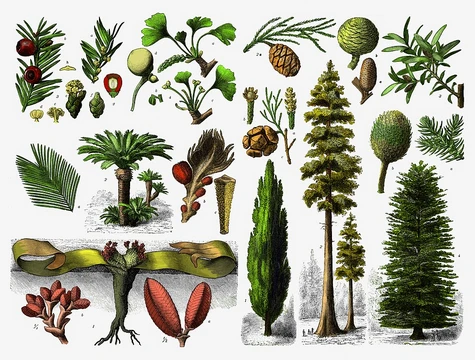
Sequoia sempervirens
Tallest living tree species, native to coastal California and Oregon.

Sequoia sempervirens, commonly known as the coast redwood, coastal redwood, or California redwood, is the sole living species of the genus Sequoia in the cypress family Cupressaceae.
- genome_size
- 26.5 gigabases
Lore & Background
The bark is very thick, up to 35 cm (1.15 ft), soft and fibrous, with a bright red-brown color when freshly exposed. The root system is composed of shallow, wide-spreading lateral roots. Leaves are variable: 15–25 mm long and flat on young trees and shaded lower branches, and scalelike, 5–10 mm long on shoots in full sun in the upper crown of older trees. The species is monoecious, with ovoid seed cones 15–32 mm long and pollen cones 4–6 mm long.
Reader's Guide
Sequoia sempervirens is significant as the tallest living tree species on Earth and among the longest-living trees. Its genetic makeup is unusual among conifers, and molecular studies suggest it may have arisen as an ancient hybrid between ancestors of the giant sequoia and dawn redwood. Many redwoods are preserved in various state and national parks, with many of the largest specimens having their own official names. The species' reliance on coastal fog for water is threatened by reduced fog in the 21st century, potentially compounded by climate change. Its legacy includes being a key species in the subfamily Sequoioideae, alongside Sequoiadendron (giant sequoia) and Metasequoia (dawn redwood).
Did You Know?
- The species is hexaploid (6n) with a chromosome count of 2n=66, unusual among conifers.
- The name 'sempervirens' means 'evergreen', a name chosen to contrast with the deciduous nature of Taxodium distichum (baldcypress), not because of a shared genus placement.
Physical Magnitude & Architecture
In ordinary stands, individuals grow between 60 and 100 meters tall with trunks roughly 9 meters across. The trunk grows with notable straightness, topped by a conical crown whose branches extend horizontally or droop slightly. The bark is a signature feature: up to 35 centimeters thick, soft and fibrous in texture, and a vivid red-brown when freshly exposed before darkening with age. Rather than plunging deep, the root system spreads laterally in a shallow, wide network. Foliage shifts dramatically by position—young trees and shaded lower limbs carry flat leaves 15 to 25 millimeters long, while full-sun upper-crown shoots bear scalelike leaves of only 5 to 10 millimeters. Both forms are dark green above and show two blue-white stomatal bands below. As a monoecious conifer, the tree bears both pollen and seed cones on the same individual; the ovoid seed cones measure 15 to 32 millimeters, carry 15 to 25 spirally arranged scales, and each scale holds three to seven tiny winged seeds.
Genetic Architecture & Evolutionary Origins
Among conifers, the coast redwood's genome is singular. Carrying a chromosome count of 2n=66, it is a hexaploid and likely an allopolyploid, a configuration pointing to hybrid ancestry. Both its mitochondrial and chloroplast genomes are inherited paternally, a trait that sets it apart from most plant lineages. Its evolutionary placement has proven stubborn. The redwood, giant sequoia, and dawn redwood are each other's nearest living relatives, yet phylogenetic signals conflict. That inconsistency strongly implies reticulate evolution—an ancient hybridization between the ancestors of the other two genera giving rise to Sequoia. Pinning down exact timing remains elusive, because the oldest fossil evidence for these lineages stretches back to the Jurassic and the record is fragmentary.
Range, Habitat & Historical Loss
The strip's width varies between 8 and 75 kilometers, hemmed in by the ocean on one side and by rainfall or topographic limits on the other; southern California simply does not receive enough moisture to sustain the species. Today, many of the oldest and largest individuals are sheltered within state and national parks, and a number of the greatest specimens have been given their own official names, standing as living testaments to a forest that once clothed a far wider band of the Pacific shore.
Taxonomic History & Naming
The redwood's scientific name emerged over more than two decades of 19th-century botanical work. How Endlicher arrived at the name Sequoia has never been explained. The everyday term 'redwood' alludes to the reddish heartwood revealed when bark is stripped, a trait it shares with the giant sequoia. Names reserved for this species alone—California redwood, coastal redwood, coast redwood—separate it from its two close kin in the subfamily Sequoioideae. Gibbons, a founding member of the California Academy of Sciences, recorded a hollow redwood shell in the Oakland Hills with a breast-height diameter of 9.9 meters, a girth matched only by the Fieldbrook Stump in Humboldt County at 9.8 meters.
Frequently Asked Questions
Who is Sequoia sempervirens?
Sequoia sempervirens is the sole surviving species in the genus Sequoia, a coniferous tree placed in the cypress family Cupressaceae. It is native to the narrow, fog-drenched coastal strips of California and the southwestern tip of Oregon.
Why is Sequoia sempervirens important?
As a monoecious, centuries-old conifer it anchors entire coastal ecosystems, shaping the fog-belt microclimate and providing structural habitat for countless other species. Its longevity also makes each individual a living archive of thousands of years of regional climate history.
What makes Sequoia sempervirens different from other redwoods?
It is the only extant member of the genus Sequoia, setting it apart from the giant sequoia, which belongs to the separate genus Sequoiadendron. Its strict dependence on marine fog and its exclusive Pacific-coastal habitat distinguish it ecologically from any other conifer.
More in Conifers And Gymnosperms 25-34
Elsewhere in the Conifers And Gymnosperms universe
Spotted an error? Know more?
This is a living reference — every entry is fact-audited, and reader corrections feed straight into our audit queue. Suggest an edit · See this site's audit record