Taxus
Genus of long-lived conifers known for toxicity and bow wood.

Yews, the common name for the genus *Taxus*, are coniferous trees or shrubs in the family Taxaceae. They grow across the northern hemisphere's temperate zones, from as far north as Norway down to the South Celebes, with some populations also found in tropical highlands. The oldest known fossils of these plants date to the Early Cretaceous.
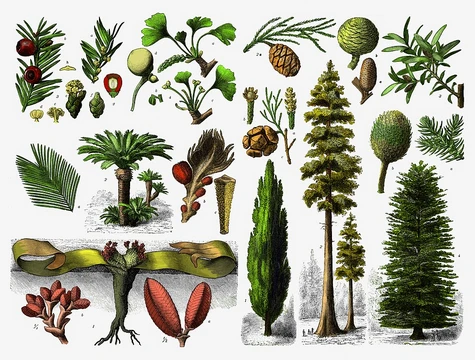
These plants grow slowly and can live for a very long time, reaching heights between 2.5 and 20 meters. Their bark is reddish, and their leaves are flat, lance-shaped, dark green, and arranged spirally on the stem, though the leaf bases twist to form two flat rows. Male cones are small and globe-shaped, releasing pollen in early spring. Most yews are dioecious, but some individuals can change sex or be monoecious. The seed cones are highly modified: each holds a single seed partly wrapped in a soft, bright red, berry-like structure called an aril, which is open at the end. Birds like thrushes and waxwings eat the arils and disperse the hard seeds in their droppings, with the arils maturing over two to three months to improve seed dispersal.
The Latin word *Taxus* likely came from the Scythian word *taxša*, meaning both "yew" and "bow," as the Scythians used yew wood for bows. All yew species are closely related, and some botanists consider them all subspecies or varieties of a single widespread species, *Taxus baccata*, the first scientifically described yew. Classification varies widely: in 1903, RKF Pilger grouped all yews under *T. baccata*, while in 2007, R. W. Spjut split them into 25 species and over 50 varieties based on small differences. Geographic distribution has traditionally guided species identification, but Asian species are harder to classify. *Taxus contorta* in the Western Himalaya and *Taxus sumatrana* in Malesia are generally accepted, but overlapping ranges in the Eastern Himalaya, China, and subtropical Southeast Asia have caused confusion. Species like *Taxus chinensis*, *Taxus mairei*, and *Taxus wallichiana* were only clarified in the 21st century using molecular phylogenetics. The most distinct is the Sumatran yew (*T. sumatrana*), with sparse, sickle-shaped yellow-green leaves. The Mexican yew (*Taxus globosa*) is also relatively distinct, with foliage between that of the Sumatran yew and other species. The Florida yew, Mexican yew, and Pacific yew are rare and listed as threatened or endangered.
Yews typically grow in the understory or canopy of moist temperate or tropical mountain forests. Their elevation ranges from 3,000 meters in tropical forests to near sea level at their northernmost limits. They are common in landscaping, leading to widespread naturalized populations in the United States, where *T. baccata* and *Taxus cuspidata* are popular ornamental shrubs. *T. baccata* is found across Europe and into western Asia, while *T. cuspidata* occurs in East Asia, including China, Japan, Korea, and Sakhalin. *Taxus brevifolia* ranges from California to Montana and Alaska in the United States, and *Taxus canadensis* appears in the northeastern United States and southeast Canada.
Plants of the World Online recognizes 12 confirmed species. Extinct fossil species include *Taxus engelhardtii* from the Oligocene of Bohemia, *Taxus inopinata* from the Upper Miocene, *Taxus masonii* from the Eocene Clarno Formation in Oregon, and *Taxus schornii* from the Miocene of northern Idaho. Common hybrids include *Taxus × media* (*T. baccata* × *T. cuspidata*) and *Taxus × hunnewelliana* (*T. cuspidata* × *T. canadensis*).
All yew species contain highly poisonous taxine alkaloids, with some variation between species. Every part of the tree except the arils contains these alkaloids. The arils are edible and sweet, but the seed inside is dangerously poisonous: unlike birds, the human stomach can break down the seed coat, releasing toxins that can be fatal if the "berries" are eaten without removing the seeds. Grazing animals like cattle and horses sometimes die after eating yew leaves, though deer can break down the poisons and browse yew freely, often restricting wild yews to cliffs and steep slopes. The foliage is also eaten by the larvae of some Lepidoptera, such as the moth willow beauty.
All parts of a yew plant are toxic to humans except the arils (which still contain a toxic seed). Male and dioecious yews release cytotoxic pollen, which can cause headaches, lethargy, aching joints, itching, skin rashes, and trigger asthma. These pollen grains are extremely small and can pass through window screens.
- field
- Botany
- known_for
- Yew trees, source of taxine alkaloids and traditional bow wood
- native_range
- Temperate zones of the northern hemisphere, from Norway to South Celebes
- oldest_fossil
- Early Cretaceous
Lore & Background
Taxus is the Latin word for this tree, and its wood was used to make javelins. The Latin word is probably borrowed, via Greek τόξον tóxon, from taxša, the Scythian word used for 'yew' and 'bow' because the Scythians used its wood to make their bows. All yews are very closely related, and some botanists treat them all as subspecies or varieties of just one widespread species, Taxus baccata. Attempts at taxonomy vary from describing all yews as subspecies of T. baccata to splitting species by very small morphological differences, with some species traditionally recognized by geographic distribution. Asian species have been more difficult to classify, with species such as Taxus chinensis, Taxus mairei, and Taxus wallichiana elucidated only in the 21st century with the aid of molecular phylogenetics.
Reader's Guide
Yews have been significant in human history primarily for their wood, which is very springy and was traditionally used to make bows, especially the longbow. All species of yew contain highly poisonous taxine alkaloids, with all parts except the arils containing the alkaloid. The arils are edible and sweet, but the seed is dangerously poisonous to humans. Grazing animals, particularly cattle and horses, are sometimes found dead near yew trees after eating the leaves, though deer can break down the poisons. The Fortingall Yew has been considered the oldest tree in Europe, at something over 2,000 years old. Male yews release cytotoxic pollen, which can cause headaches, lethargy, aching joints, itching, and skin rashes, and is a trigger for asthma. Completely female yews have an OPALS allergy scale rating of 1 and are considered 'allergy-fighting.'
Did You Know?
- The oldest known fossil species of Taxus are from the Early Cretaceous.
- All parts of a yew plant except the arils contain highly poisonous taxine alkaloids.
- Male yews release cytotoxic pollen that can cause headaches, lethargy, aching joints, itching, and skin rashes.
Frequently Asked Questions
What is Taxus?
Taxus is a genus of coniferous trees and shrubs commonly called yews, belonging to the family Taxaceae. They are slow-growing, exceptionally long-lived plants that can range from small shrubs up to about 20 meters in height.
Where are yews native to?
Yews occur across temperate zones of the northern hemisphere, stretching from Norway in the far north to South Celebes in the south. Some populations also persist in tropical highland regions.
What is Taxus most famous for?
Yews are widely recognized for producing taxine alkaloids that make them highly toxic, as well as for supplying the wood traditionally used to craft bows. This dual reputation for danger and utility has made them a standout genus in conifer fandom.
How far back do yews go, and how long do they live?
The oldest known fossil species of Taxus date to the Early Cretaceous, making them one of the oldest surviving conifer lineages. Their slow growth rate supports an exceptional lifespan, with many individuals persisting for centuries.
What do yew trees look like and how do they reproduce?
Yews feature reddish bark, flat lance-shaped dark-green leaves, and are mostly dioecious, so individual plants are either male or female. Males shed pollen in early spring, while females bear seed cones with a single seed partly wrapped in a fleshy aril.
More in Conifers And Gymnosperms 25-34
Elsewhere in the Conifers And Gymnosperms universe
Spotted an error? Know more?
This is a living reference — every entry is fact-audited, and reader corrections feed straight into our audit queue. Suggest an edit · See this site's audit record