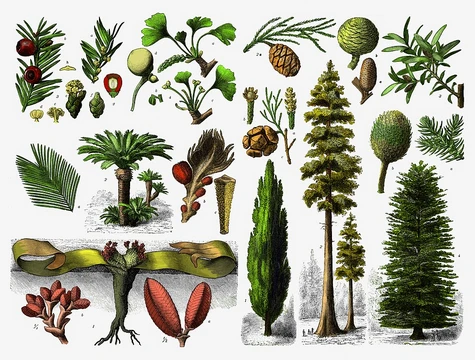
Taxodium distichum
A flood-tolerant deciduous conifer with rot-resistant heartwood.

Taxodium distichum, commonly known as bald cypress, swamp cypress, or red cypress, is a deciduous conifer in the family Cupressaceae native to the Southeastern United States. It is noted for its russet-red fall color, extreme flood tolerance, and rot-resistant heartwood, making it valuable for timber and widely planted in public spaces.
- common_names
- bald cypress, swamp cypress, white cypress, tidewater red cypress, gulf cypress, red cypress
- family
- Cupressaceae
- native_range
- Southeastern United States, from New Jersey to Florida and west to Texas and Oklahoma, inland up the Mississippi River
- trunk_diameter
- 3–7 feet (0.9–2.1 m)
Lore & Background
Taxodium distichum is a large, slow to fast-growing, long-lived tree with a main trunk often surrounded by cypress knees. Its bark is grayish brown to reddish brown, thin, and fibrous. The needle-like leaves turn yellow or copper red in autumn, and the tree is deciduous. It is monoecious, with male and female cones on the same plant; male cones emerge on panicles 4–5 inches long, and female cones are round, resinous, and green, turning hard and brown as they mature. Each cone contains 20 to 40 large seeds, the largest of any Cupressaceae species, and heavy seed crops occur every 3–5 years.
Reader's Guide
The bald cypress is significant for its adaptability to a wide range of soil types, including wet, salty, dry, and swampy conditions, and its tolerance of atmospheric pollution. Its rot-resistant heartwood makes it valued for fence posts, doors, flooring, caskets, and other items. The National Champion Bald Cypress, located in Cat Island National Wildlife Refuge near St. The species' ability to grow in full sunlight to partial shade and its use in groupings in public spaces further underscore its ecological and ornamental value.
Frequently Asked Questions
Who is Taxodium distichum?
Taxodium distichum is a deciduous conifer in the cypress family (Cupressaceae) that grows natively across the flat, wet lowlands of the American Southeast. Fans often call it bald cypress, swamp cypress, or red cypress, and it stands out as one of the very few conifers that sheds all its needles every winter.
What are Taxodium distichum's powers/role?
Its standout ability is tolerating months of standing water without dying, a trait almost unheard of among conifers. It also produces heartwood that resists decay remarkably well, making it a long-standing favorite for outdoor construction, boat-building, and fence posts.
Where does Taxodium distichum call home?
Its native stretch runs from New Jersey down through Florida and westward into Texas and Oklahoma, following the Mississippi River valley and its tributaries. It thrives in slow-moving rivers, oxbow lakes, and bottomland swamps where the water table stays high year-round.
Why is Taxodium distichum important to the canon?
Beyond serving as a keystone species in wetland habitats, its durable, rot-resistant timber has made it a go-to material for docks, outdoor structures, and furniture for generations. It is also one of the most widely planted shade and ornamental trees in parks and streetscapes across the country.
More in Conifers And Gymnosperms 25-34
Elsewhere in the Conifers And Gymnosperms universe
Spotted an error? Know more?
This is a living reference — every entry is fact-audited, and reader corrections feed straight into our audit queue. Suggest an edit · See this site's audit record