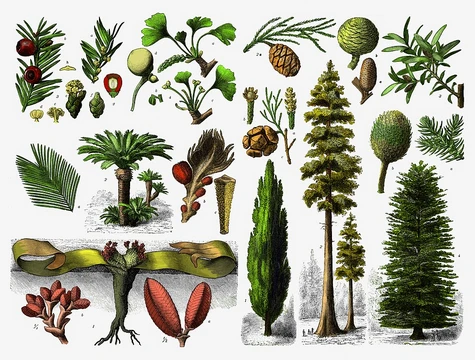
Pinus taeda

Pinus taeda, commonly known as loblolly pine, is a species of pine native to the Southeastern United States, from East Texas to Florida up to southern New Jersey. It is the second-most common species of tree in the United States after red maple, and is regarded as the most commercially important tree in the Southeastern U.S. for its timber.
- field
- Botany, Forestry
- native_range
- Southeastern United States (East Texas to Florida, up to southern New Jersey)
- known_for
- Most commercially important tree in the Southeastern U.S.; first Pinus species with complete genome sequenced; second-most common tree in the U.S.
- genome_size
- 22 billion base pairs (seven times larger than human genome)
Lore & Background
Loblolly pine can reach a height of 30–35 meters, with exceptional specimens up to 50 meters, making it the largest of the southern pines. Its needles are in bundles of three, 12–22 centimeters long, and yellowish-green to grayish green. The bark is reddish brown and deeply fissured into irregular, broad, scaly plates on older trees. The species is one of the fastest growing pines, averaging 2 feet per year, and its lumber is marketed as yellow pine, used similarly to other southern pines. The tallest known loblolly pine, 51.4 meters tall, and the largest, measuring 42 cubic meters in volume, are both in Congaree National Park. The common name 'loblolly' derives from an old British dialect word for thick porridge, used in the southern United States to mean 'a mudhole; a mire,' referencing the pine's prevalence in lowlands and swampy areas. Other historical names include oldfield pine, bull pine, rosemary pine, and North Carolina pine. The scientific name Pinus taeda refers to the resinous wood. With wildfire suppression, loblolly pine has become prevalent in parts of the Deep South once dominated by longleaf pine and slash pine.
Reader's Guide
Pinus taeda holds significant ecological and economic importance in the Southeastern United States. As the second-most common tree species in the country and the most commercially important in the region, it is extensively grown in plantations for lumber and wood pulp. Its rapid growth rate—among the fastest of southern pines—makes it a valuable resource for the timber industry, where its wood is classified as southern yellow pine. The species also plays a key role in forest ecology, particularly in areas where wildfire suppression has allowed it to replace longleaf and slash pines. Scientifically, loblolly pine is notable for being the first of over 100 Pinus species to have its complete genome sequenced. This genomic work has provided insights into conifer biology and the challenges of sequencing large, complex genomes. Its seeds traveled to the moon on Apollo 14, and the resulting 'moon trees' remain as living symbols of space exploration. The species also features in golf history through the Eisenhower Tree at Augusta National. Its ability to grow in acidic clay soils and its prevalence in lowlands have made it a familiar part of the Southern landscape.
Did You Know?
- Loblolly pine is the second-most common species of tree in the United States, after red maple.
- Loblolly pine seeds were carried aboard the Apollo 14 flight and planted in several locations in the US, including the White House grounds.
- The tallest known loblolly pine, 51.4 meters tall, and the largest, measuring 42 cubic meters in volume, are both in Congaree National Park.
More in Conifers And Gymnosperms 1-24
Elsewhere in the Conifers And Gymnosperms universe
Spotted an error? Know more?
This is a living reference — every entry is fact-audited, and reader corrections feed straight into our audit queue. Suggest an edit · See this site's audit record