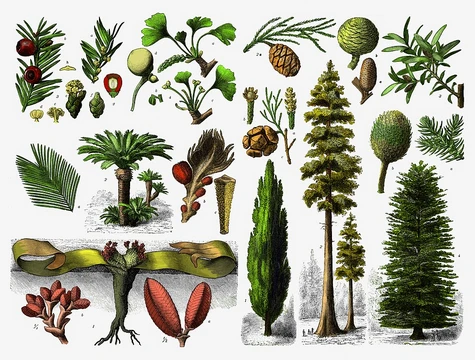
Tsuga
Genus of conifers with hemlock common name, not poisonous.

Tsuga (pronounced TSOO-guh, from the Japanese name for *Tsuga sieboldii*) is a genus of conifers in the pine family, Pinaceae. Its common name, "hemlock," comes from the similar smell of its crushed leaves to the unrelated poisonous plant hemlock—but unlike that plant, Tsuga species are not toxic. Depending on the taxonomic authority, the genus contains eight to ten species, with four native to North America and four to six found in eastern Asia. These trees are medium-sized to large, reaching 10 to 60 meters (33–197 feet) tall. Their crowns are conical or irregular, especially in some Asian species, and the leading shoots usually droop. The bark is scaly, deeply furrowed, and gray to brown. Branches grow horizontally from the trunk, often in flattened sprays that bend downward at the tips. Short spur shoots are weakly to moderately developed. Young twigs and stem tips are flexible and often hang down. Stems are rough with pulvini that remain after leaves fall. Winter buds are ovoid or globose, rounded at the tip, and not resinous. Leaves are flattened to slightly angular, 5–35 mm (3/16–1 3/8 inches) long and 1–3 mm (1/32–1/8 inch) wide. They grow singly in a spiral arrangement, with twisted bases so the leaves lie flat on either side of the stem (or, rarely, radially). Near the base, each leaf narrows abruptly to a petiole on a forward-angled pulvinus; the petiole is twisted so it runs almost parallel to the stem. Leaf tips may be notched, rounded, or pointed. The underside has two white stomatal bands (inconspicuous in *T. mertensiana*) separated by an elevated midvein. The upper surface lacks stomata, except in *T. mertensiana*. Each leaf has one resin canal beneath a single vascular bundle. Pollen cones grow singly from lateral buds. They are 3–5 mm (1/8–3/16 inch) long, ovoid, globose, or ellipsoid, yellowish-white to pale purple, and borne on a short stalk. The pollen itself has a saccate, ring-like structure at its distal pole, occasionally more or less doubly saccate. Seed cones appear on one-year-old twigs. They are small, ovoid-globose or oblong-cylindric, 15–40 mm (5/8–1 5/8 inches) long—except in *T. mertensiana*, where they are cylindrical and longer (35–80 mm, or 1 1/2–3 1/4 inches). Cones are solitary, terminal (or rarely lateral), pendulous, and either stalkless or on a short stalk up to 4 mm (3/16 inch) long. They mature in 5–8 months, and seeds are shed soon after; the cones themselves fall shortly after seed release or up to a year or two later. Seed scales are thin, leathery, and persistent, varying in shape and lacking an apophysis or umbo. The bracts are small and included. Seeds are small (2–4 mm, or 3/32–5/32 inch long), winged (wing 8–12 mm, or 5/16–1/2 inch), and contain small adaxial resin vesicles. Germination is epigeal, with seedlings having 4–6 cotyledons. Mountain hemlock (*T. mertensiana*) is unusual: its leaves are less flattened, arranged all around the shoot, and have stomata on both sides, giving the foliage a glaucous color. Its cones are the longest in the genus (35–80 mm) and cylindrical rather than ovoid. Some botanists place it in a separate genus, *Hesperopeuce mertensiana*, though it is more commonly treated as a subgenus. The oldest fossils linked to the genus are twigs from the Early Cretaceous of Inner Mongolia, China, though their relationship to modern Tsuga is unclear. The earliest pollen attributed to Tsuga comes from the Upper Cretaceous of Poland, about 90 million years ago. Abundant remains appear only from the Eocene onward, when the modern crown group is thought to have diversified. Tsuga was once present in Europe but became extinct there during the Middle Pleistocene (around 780,000–440,000 years ago) due to climate change from Quaternary glaciation. Another species, bristlecone hemlock, first described as *T. longibracteata*, is now placed in the distinct genus *Nothotsuga*. It differs from Tsuga in having erect (not pendulous) cones with exserted bracts and male cones clustered in umbels, features more similar to the genus *Keteleeria*. Recent phylogenomic work—based on 881 nuclear genes plus data from 60 plastid and 23 mitochondrial loci—suggests the genus likely originated in North America, with some members later spreading to East Asia via the Bering Land Bridge. Tsuga appears to have two clades: one containing western North American species (*T. mertensiana* and *T. heterophylla*), and another containing eastern North American and Asian species. Complex reticulate evolution, especially among East Asian taxa, has complicated their relationships. For example, *T. chinensis* forms a paraphyletic group, indicating the need for further research and possible taxonomic revision.
- field
- Botany
- known_for
- Conifers in the pine family, important timber and horticultural trees
- species_count
- 8–10 (depending on authority)
- distribution
- North America and eastern Asia
Lore & Background
Hemlocks are medium-sized to large evergreen trees, 10–60 meters tall, with conical to irregular crowns and drooping leading shoots. Their bark is scaly and deeply furrowed, ranging from grey to brown. Leaves are flattened, 5–35 mm long, with two white stomatal bands on the underside, except in T. mertensiana which has stomata on both surfaces. Seed cones are small, ovoid to cylindrical, 15–40 mm long, except in T. mertensiana where they reach 35–80 mm.
Reader's Guide
Tsuga species are adapted to moist, cool temperate areas with high rainfall and tolerate heavy winter snowfall and ice storms better than most trees. They are more tolerant of heavy shade than other conifers but are susceptible to drought. The two eastern North American species, T. canadensis and T. caroliniana, are under serious threat from the sap-sucking insect Adelges tsugae (hemlock woolly adelgid), introduced accidentally from eastern Asia. The wood is important in the timber industry, especially for wood pulp, and many species are used in horticulture with numerous cultivars. The oldest fossils attributed to the genus are twigs from the Early Cretaceous of Inner Mongolia, China, though their relationship to modern Tsuga is not unambiguous. Tsuga became extinct in Europe during the Middle Pleistocene due to climate change from Quaternary glaciation.
Did You Know?
- The common name 'hemlock' comes from a perceived similarity in smell to the unrelated poisonous plant hemlock, but Tsuga species are not poisonous.
- The oldest fossils attributed to Tsuga are twigs from the Early Cretaceous of Inner Mongolia, China.
- The two eastern North American species are seriously threatened by the hemlock woolly adelgid, an insect introduced from eastern Asia.
Frequently Asked Questions
Who is Tsuga?
Tsuga is a genus of evergreen coniferous trees classified within the Abietoideae subfamily of the pine family (Pinaceae). It occupies a modest but distinctive niche among the world's conifers, recognized for its aromatic foliage and ornamental appeal.
What is Tsuga's role in the plant world?
Species in this genus serve as practical timber sources and are widely planted as ornamental specimens in gardens and parks. They anchor temperate forest ecosystems on two separate continents, contributing to both ecological structure and human industry.
Why is Tsuga called 'hemlock' when it isn't poisonous?
The common name stuck because early observers noticed that crushed Tsuga needles release a scent reminiscent of the unrelated, toxic plant hemlock. Despite the misleading nickname, no member of this genus produces poisons harmful to people or wildlife.
How many species belong to Tsuga and where do they live?
Taxonomists recognize anywhere from eight to ten species, depending on which authority you follow. About four are native to North American forests, while the remaining four to six populate woodlands across eastern Asia.
Why is Tsuga important to conifer enthusiasts and botanists?
The genus spans two major continents' temperate zones and supplies both useful lumber and popular cultivated garden trees. Its relatively small species count, combined with a distinctive needle aroma, makes it a go-to subject for anyone studying or collecting conifers.
More in Conifers And Gymnosperms 25-34
Elsewhere in the Conifers And Gymnosperms universe
Spotted an error? Know more?
This is a living reference — every entry is fact-audited, and reader corrections feed straight into our audit queue. Suggest an edit · See this site's audit record