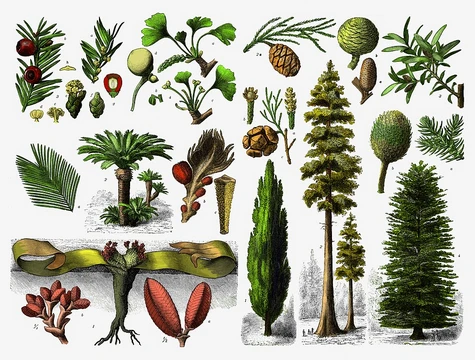
Picea glauca
A widespread North American conifer with variable forms and hybrids.

Picea glauca, commonly known as white spruce, is a species of spruce native to the northern temperate and boreal forests of North America, ranging from Alaska across Canada to Newfoundland and south into the northern United States. It is a medium-sized evergreen conifer valued for its adaptability and wide distribution, and it is also known by several common names including Canadian spruce and skunk spruce. Varietal names such as Black Hills spruce and Alberta white spruce are sometimes used, though the latter (Picea glauca var. albertiana) is often treated as a synonym or has disputed taxonomic status.
- field
- Botany
- native_range
- Canada and United States, North America
- average_height
- 15 to 30 metres (50 to 100 ft)
- seed_weight_range
- 1.1 to 3.2 mg per seed
- cone_length
- 2.5 to 7 cm (1 to 2+3⁄4 in)
Lore & Background
White spruce is a medium-sized evergreen conifer typically growing 15 to 30 metres tall, with a trunk diameter up to 1 metre. Its bark is thin and scaly, flaking in small circular plates, and its crown is narrow conical in young trees, becoming columnar with age. The needle-like leaves are glaucous blue-green above with stomatal lines, and blue-white below with two broad bands of stomata. The cones are pendulous, slender, cylindrical, and mature from green or reddish to pale brown. Seeds are small, black, and winged, dispersed mainly by wind in late summer or early fall, though cold or damp weather can cause cone scales to close and reopen in dry conditions. The root system is highly variable and adaptable, responding to soil moisture, fertility, and mechanical impedance. On restrictive soils, roots may be plate-like, but in nurseries or favorable forest conditions, white spruce develops several long 'running' roots just below the surface. Four geographical varieties have been described, though not all are accepted by all authors. These include the typical eastern white spruce, Alaska white spruce, Black Hills white spruce, and Alberta white spruce (Picea glauca var. albertiana), the latter often treated as a synonym or having disputed taxonomic status. White spruce also hybridizes with Engelmann spruce to form Picea × albertii, and with Sitka spruce in southern Alaska and northwestern British Columbia to form Picea × lutzii.
Reader's Guide
White spruce is a foundational species across North America's boreal and temperate forests, playing a key ecological role in vast regions from Alaska to Newfoundland and south into the northern United States. Its adaptability to diverse soil conditions and climates, along with its ability to hybridize with related spruces, makes it a subject of ongoing botanical study. White spruce is also notable for its variable seed characteristics, with cone maturation linked to growing degree days and seed dispersal patterns influenced by weather. The species' chemical composition includes isorhapontin, and its root system's tracheid structure varies with soil nitrogen availability. Despite its wide range, white spruce is more exacting than black spruce in ecological requirements, as noted in studies of Quebec conifers.
Did You Know?
- White spruce hybridizes with Engelmann spruce to form Picea × albertii and with Sitka spruce to form Picea × lutzii.
- The bark of mature white spruce is scaly or flaky, grey-brown or ash-brown, and mostly less than 8 mm thick.
Frequently Asked Questions
Who is Picea glauca?
Picea glauca is a medium-sized evergreen spruce native to the boreal and northern temperate forests of North America. It is known by several common names, including white spruce, Canadian spruce, and skunk spruce.
What are Picea glauca's powers or special role?
Its standout trait is sheer adaptability, allowing it to dominate a range that stretches from Alaska across Canada to Newfoundland and south into the northern United States. It also readily produces variable forms and hybridizes with neighboring spruce species.
Why is Picea glauca important in the ecosystem?
Because of its enormous geographic footprint, it anchors boreal forest communities by providing year-round structure, forage, and nesting habitat for a wide array of wildlife. It is also a commercially significant source of timber and pulp fibre.
What does Picea glauca's 'kit' look like?
Its cones are modest, measuring 2.5 to 7 cm long, and each seed is extremely light at just 1.1 to 3.2 milligrams. The overall silhouette is the classic dense, conical evergreen shape fans associate with spruces.
More in Conifers And Gymnosperms 1-24
Elsewhere in the Conifers And Gymnosperms universe
Spotted an error? Know more?
This is a living reference — every entry is fact-audited, and reader corrections feed straight into our audit queue. Suggest an edit · See this site's audit record