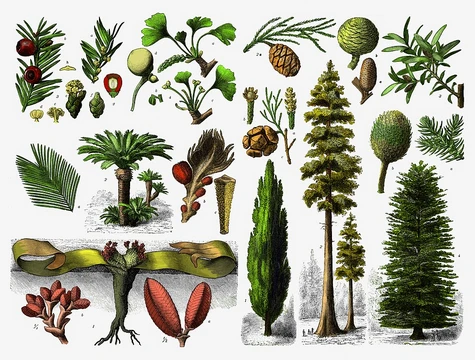
Taxus baccata
Ancient evergreen tree, toxic yet culturally and medicinally significant.

Taxus baccata is an Old World species of evergreen tree in the family Taxaceae, originally known as yew. It is a woodland tree native to much of Eurasia and Northwest Africa, valued for its wood and ornamental use, and noted for its toxicity and longevity.
- Scientific name
- Taxus baccata
- Family
- Taxaceae
- Native range
- Eurasia and Northwest Africa
- Maximum height
- 20–28 m (65–92 ft)
- Maximum trunk diameter
- 2–4 m (6.5–13 ft)
- Toxicity
- All parts except aril are poisonous
- Conservation status
- Endangered in parts of its range
Lore & Background
The generic name Taxus may derive from the Greek toxon, meaning bow, referencing its historical use for longbows. The species name baccata is Latin for 'bearing berries'. The word yew originates from Old English īw, ēow, tracing back to Proto-Indo-European roots. The tree is small to medium-sized, growing up to 28 m tall, with reddish-brown bark and flat, dark green leaves arranged spirally but appearing in two flat rows. Its seed cones are modified into a single seed surrounded by a fleshy, bright red aril that is sweet and gelatinous, while the male cones are globose and shed pollen in early spring. Yews are mostly dioecious, with occasional individuals changing sex.
Reader's Guide
Taxus baccata holds enduring significance as a source of wood for longbows and musical instruments, and as an ornamental tree in churchyards where it symbolizes death, immortality, and rebirth. Its toxicity—affecting all parts except the aril—has led to livestock fatalities and human poisonings, with no known antidote. The tree's taxine alkaloids are cardiotoxic, and dried material retains toxicity. Historically, overharvesting for bows and livestock protection threatened populations, and it remains endangered in parts of its range due to land use and pharmaceutical demand for taxanes. Conservation efforts include the Yew Conservation Hedge Project in the UK and programs in Catalonia and northern Iberia. The species is also allergenic, with male trees rated 10 on the OPALS scale. Its wood, though slow-growing, is valued for hedging and topiary, and its clippings provide precursors for the chemotherapy drug taxol.
Did You Know?
- All parts of the yew except the fleshy aril are poisonous, with toxins absorbable through inhalation, ingestion, and skin contact.
- The aril is gelatinous and very sweet tasting, and is eaten by birds that disperse the seeds.
- Yew wood was prized for making longbows and musical instruments such as lutes.
Frequently Asked Questions
Who is Taxus baccata?
Taxus baccata is the common yew, an evergreen conifer in the family Taxaceae. It is a slow-growing woodland tree capable of reaching 20 to 28 meters in height with a trunk up to 4 meters across.
What are Taxus baccata's powers and role?
The yew is notorious for being highly toxic—every part of the tree is poisonous except the fleshy red aril that wraps around its seed. Despite that danger, its dense, interlocking grain has made it a prized timber for centuries, and the alkaloids in its bark have been harnessed in modern oncology.
How does Taxus baccata's story end?
There is no dramatic finale; the yew is one of the longest-lived tree species, with individuals surviving well past a thousand years. Its ability to resprout from old stumps means a single yew can persist across many centuries, outlasting most of the landscape around it.
Why is Taxus baccata important?
The yew occupies a unique niche as a source of durable timber, a figure in folklore, and—most notably in modern times—the biological basis for the anticancer agent taxol. It also plays a steady ecological role as a shade-tolerant canopy tree in its native woodlands.
Where does Taxus baccata call home?
This Old World species is native across much of Eurasia and extends into Northwest Africa. It favors woodland habitats and has since been planted as an ornamental well beyond its natural range.
More in Conifers And Gymnosperms 25-34
Elsewhere in the Conifers And Gymnosperms universe
Spotted an error? Know more?
This is a living reference — every entry is fact-audited, and reader corrections feed straight into our audit queue. Suggest an edit · See this site's audit record