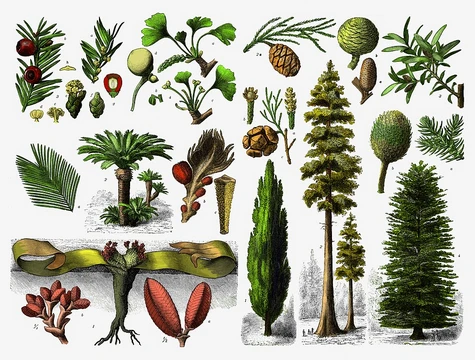
Sequoioideae
Subfamily of conifers containing the world's largest and tallest trees.

Sequoioideae, commonly referred to as redwoods, is a subfamily of coniferous trees within the family Cupressaceae, ranging in the northern hemisphere. It includes the largest and tallest trees in the world and reached its peak of diversity during the early Cenozoic. Three living species are known: the coast redwood (Sequoia sempervirens), the giant redwood (Sequoiadendron giganteum), and the dawn redwood (Metasequoia glyptostroboides).
- distribution
- Sequoia and Sequoiadendron are native to the western United States; Metasequoia glyptostroboides is native only to a small region in central China
- conservation_status
- Sequoia sempervirens and Sequoiadendron giganteum are Endangered; Metasequoia glyptostroboides is Critically Endangered in the wild
Lore & Background
The three redwood subfamily genera are Sequoia from coastal California and Oregon, Sequoiadendron from California's Sierra Nevada, and Metasequoia in China. Only Sequoia and Sequoiadendron are known for massive trees; Metasequoia trees are deciduous, grow much smaller, and can live in colder climates. The trees can live for thousands of years. Threats include logging, fire suppression, and burl poaching. Multiple studies support that Sequoioideae are monophyletic, with most phylogenies placing Sequoia as sister to Sequoiadendron and Metasequoia as the out-group. Sequoioideae and Athrotaxidoideae are thought to have diverged during the Cretaceous. Reticulate evolution has been proposed for Sequoia's origin. Yang et al. found that Sequoia clustered with Metasequoia in a tree generated using the LFY gene but with Sequoiadendron in a tree generated with the NLY gene, supporting the hypothesis that Sequoia resulted from a hybridization event involving Metasequoia and Sequoiadendron. However, the long evolutionary history of the three genera makes resolving specifics difficult.
Reader's Guide
Sequoioideae holds significant ecological and evolutionary importance as an ancient taxon, with the oldest described species, Sequoia jeholensis, recovered from Jurassic deposits. The fossil record shows a massive expansion of range in the Cretaceous and dominance of the Arcto-Tertiary Geoflora, especially in northern latitudes. A general cooling trend beginning in the late Eocene and Oligocene reduced northern ranges, as did subsequent ice ages, forcing each species into refugial ranges. The entire subfamily is endangered, with the IUCN Red List assessing all three species as Endangered. The giant sequoia's lifecycle is connected to wildfires, and human intervention disrupting regular forest fires may have exacerbated modern fire intensity. The subfamily's legacy includes its role as common ornamental trees and its representation of ancient evolutionary adaptations persisting despite changing climate and distribution.
Did You Know?
- Sequoia sempervirens is hexaploid (2n=6x=66), a rare condition among gymnosperms.
- The extinct genus Austrosequoia, known from the Late Cretaceous-Oligocene of the Southern Hemisphere, has been suggested as a member of the subfamily.
Frequently Asked Questions
What exactly is Sequoioideae?
It is a subfamily within the Cupressaceae family that groups together the redwood trees. It is best known for housing both the tallest and the largest living trees on Earth.
How many living species belong to Sequoioideae?
Three species survive today: the coast redwood (Sequoia sempervirens), the giant redwood (Sequoiadendron giganteum), and the dawn redwood (Metasequoia glyptostroboides). The subfamily was far more diverse during the early Cenozoic era.
Where do Sequoioideae trees grow in the wild?
The coast and giant redwoods are native to the western United States, while the dawn redwood is restricted to a small area in central China. All three are northern-hemisphere species.
What is the conservation status of Sequoioideae species?
Both the coast redwood and giant redwood are listed as Endangered, while the dawn redwood is classified as Critically Endangered in the wild. All three face serious threats to their long-term survival.
Why is Sequoioideae considered so significant in the conifer world?
It holds the records for both the tallest and the largest trees ever documented, making it a standout subfamily among all gymnosperms. Its peak diversity in the early Cenozoic also makes it a key piece of the conifer evolutionary story.
More in Conifers And Gymnosperms 25-34
Elsewhere in the Conifers And Gymnosperms universe
Spotted an error? Know more?
This is a living reference — every entry is fact-audited, and reader corrections feed straight into our audit queue. Suggest an edit · See this site's audit record