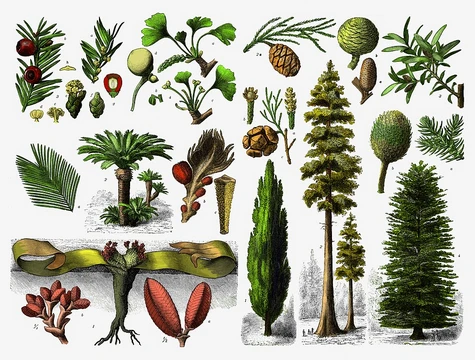
Podocarpus
A widespread genus of conifers with berry-like cones.

Here is the rewritten encyclopedia entry for *Podocarpus*:
**Podocarpus** is a genus of conifers and the largest, most widespread group within the podocarp family (Podocarpaceae). These evergreen plants range from shrubs to trees, typically growing 1 to 25 meters tall, though some can reach 40 meters. Their cones are distinctive: two to five fused scales form a fleshy, brightly colored, berry-like structure at maturity. This attracts birds, which eat the cones and disperse the seeds. According to Plants of the World Online, the genus contains 116 accepted species, though other authorities recognize between 97 and 107, depending on how species boundaries are drawn. Several species are grown as ornamentals in parks and large gardens; the cultivar 'County Park Fire' has received the Royal Horticultural Society's Award of Garden Merit.
The name *Podocarpus* comes from the Greek *pous* (foot) and *karpós* (fruit). Common names for various species include "yellowwood" and "pine," as seen in the plum pine (*Podocarpus elatus*) and Buddhist pine (*Podocarpus macrophyllus*).
These plants are evergreen woody species, mostly trees but sometimes shrubs. The tallest trees can reach 40 meters, while some shrubby forms have a decumbent (trailing) growth habit. Primary branches grow in pseudowhorls around the trunk. Bark may be scaly or fibrous and peeling in vertical strips. Terminal buds are distinctive, with bud scales that are often overlapping and sometimes spreading. Leaves are simple, flattened, and either stalkless or with short stalks. They are arranged spirally, though some shoots may show a subopposite pattern. Leaf shapes are usually linear-lanceolate or linear-elliptic, but can be broader (lanceolate, ovate, or nearly elliptic) in some species. Juvenile leaves are often larger than adult leaves but similar in shape. The leaves are leathery with a clear midrib, and stomata are usually confined to the underside, forming two bands around the midrib.
Most *Podocarpus* species are dioecious—male pollen cones and female seed cones grow on separate plants—though some are monoecious. Cones develop from axillary buds and may be solitary or clustered. Pollen cones are long and catkin-like, either stalkless or on short stalks. Each consists of a slender axis with many spirally arranged microsporophylls; each triangular microsporophyll has two pollen sacs at its base. The pollen is bisaccate (with two air bladders). Seed cones are highly modified: at maturity, the few cone scales swell and fuse. These cones are stalked and often solitary. They contain two to five scales, but only the topmost one (or rarely two) is fertile, each bearing one ovule. The infertile basal scales fuse and swell into a succulent, usually brightly colored receptacle. Each cone typically holds one seed, sometimes two or more. The seed sits at the tip of the receptacle and is completely covered by a fleshy modified scale called an epimatium, which is usually green but can be bluish or reddish in some species.
The genus is naturally distributed across much of Africa, Asia, Australia, Central and South America, and several South Pacific islands. In the Americas, it ranges from southern Chile north to Mexico; in the Asia-Pacific region, from New Zealand north to Japan. As recently as the Late Pliocene, *Podocarpus* also grew in the northern United States. *Podocarpus* and the Podocarpaceae were endemic to the ancient supercontinent Gondwana, which broke apart between 105 and 45 million years ago. It is a characteristic tree of the Antarctic flora, which evolved in the cool, moist climate of southern Gondwana. As continents drifted north and became drier and hotter, podocarps and other Antarctic flora elements generally retreated to humid regions, especially in Australia, where sclerophyll genera like *Acacia* and *Eucalyptus* became dominant. The flora of Malesia (including the Malay Peninsula, Indonesia, the Philippines, and New Guinea) is mostly derived from Asia but retains many Gondwanan elements, including other Podocarpaceae genera (*Dacrycarpus*, *Dacrydium*, *Falcatifolium*, *Nageia*, *Phyllocladus*, and the Malesian endemic *Sundacarpus*), as well as *Agathis* in the Araucariaceae.
The genus is divided into two subgenera, *Podocarpus* and *Foliolatus*, distinguished by cone and seed features. In subgenus *Podocarpus*, the cone lacks lanceolate bracts at its base, and the seed usually has an apical ridge. These species are found in temperate forests of Tasmania, New Zealand, and southern Chile, with a few in tropical highlands of Africa and the Americas. In subgenus *Foliolatus*, the cone is subtended by two lanceolate bracts ("foliola"), and the seed usually lacks an apical ridge. These species are tropical and subtropical, concentrated in eastern and southeastern Asia and Malesia, overlapping with subgenus *Podocarpus* in northeastern Australia and New Caledonia. Species within the Podocarpaceae have been reclassified multiple times based on genetic and physiological evidence; many formerly placed in *Podocarpus* now belong to other genera. Classification schemes have moved species between *Nageia* and *Podocarpus*, and in 1969, de Laubenfels split the large genus *Podocarpus* into *Dacrycarpus*, *Decussocarpus* (later revised to *Nageia*), *Prumnopitys*, and *Podocarpus*. Some species of *Afrocarpus* were also once included in *Podocarpus*.
- field
- Botany
- known_for
- Most numerous and widely distributed genus of the Podocarpaceae family
- distribution
- Africa, Asia, Australia, Central and South America, South Pacific islands
Lore & Background
Podocarpus species are evergreen woody plants, generally trees but also shrubs, with a natural distribution spanning much of Africa, Asia, Australia, Central and South America, and several South Pacific islands. The genus occurs from southern Chile north to Mexico in the Americas and from New Zealand north to Japan in the Asia-Pacific region. As recently as the Late Pliocene, Podocarpus had a range in the Northern United States. Podocarpus is a characteristic tree of the Antarctic flora, which originated in the cool, moist climate of southern Gondwana. As continents drifted north and became drier and hotter, podocarps generally retreated to humid regions, especially in Australia.
Reader's Guide
Podocarpus holds significance as the most numerous and widely distributed genus within the Podocarpaceae, with a natural range that spans multiple continents and islands, reflecting its ancient Gondwanan origins. The genus is notable for its highly modified seed cones, which form fleshy, brightly colored receptacles that attract birds for seed dispersal. Species are cultivated as ornamental plants, with the cultivar 'County Park Fire' receiving the Royal Horticultural Society's Award of Garden Merit. The classification of Podocarpus has undergone reshuffling based on genetic and physiological evidence, with many species formerly assigned to it now placed in other genera such as Afrocarpus, Dacrycarpus, Nageia, and Prumnopitys. The two subgenera, Podocarpus and Foliolatus, are distinguished by cone and seed morphology, though the sections within them are mostly poorly supported by molecular evidence. The genus includes species known by common names such as yellowwood, plum pine, and Buddhist pine.
Did You Know?
- The name Podocarpus comes from Greek 'pous' (foot) and 'karpós' (fruit).
- The fleshy cones attract birds, which eat them and disperse seeds in their droppings.
- The cultivar 'County Park Fire' has won the Royal Horticultural Society's Award of Garden Merit.
- Podocarpus and the Podocarpaceae were endemic to the ancient supercontinent Gondwana.
More in Conifers And Gymnosperms 1-24
Elsewhere in the Conifers And Gymnosperms universe
Spotted an error? Know more?
This is a living reference — every entry is fact-audited, and reader corrections feed straight into our audit queue. Suggest an edit · See this site's audit record