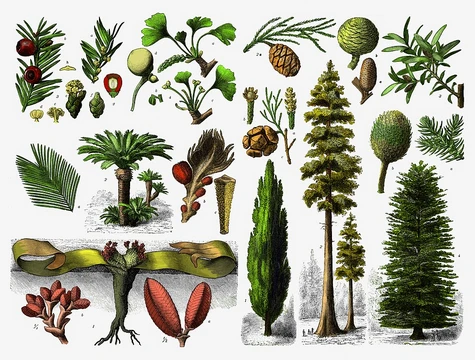
Pinus halepensis
A resilient Mediterranean pine valued for timber, resin, and culture.

Pinus halepensis, commonly known as the Aleppo pine or Jerusalem pine, is a species of pine native to the Mediterranean region. The tree is notable for its resilience in hot, dry climates and its wide use in forestry, cuisine, and culture.
- field
- Botany
- native_range
- Mediterranean region (Morocco to Greece, Syria, Lebanon, Turkey, Jordan, Israel, Palestine)
- height
- 15–25 metres (49–82 feet)
- trunk_diameter
- Up to 60 cm (24 in), exceptionally up to 1 m (3 ft 3 in)
- cone_length
- 5–12 cm (2–4+3⁄4 in)
- seed_dispersal
- Wind-dispersed
Lore & Background
The tree's bark is orange-red, thick and fissured at the base, thin and flaky in the upper crown. Its needles are slender, yellowish green, and produced in pairs. Cones are narrow, ripening glossy red-brown after 24 months, and open slowly over several years, accelerated by heat such as forest fires. Seeds are 5–6 mm long with a 20 mm wing, dispersed by wind.
Reader's Guide
Pinus halepensis is a significant species in Mediterranean forestry, especially in Algeria and Morocco, where it is planted for its fine timber. In Israel, it has been extensively planted by the Jewish National Fund, notably in Yatir Forest on the edge of the Negev desert, where its survival exceeded expectations. However, some argue that replacing natural oak maquis with pine stands has created 'ecological deserts' and altered species assemblages. The tree is also used in local cuisines: its resin flavors Greek retsina wine, its pine nuts are used in Tunisian asidet zgougou and Maltese prinjolata. As an ornamental, it is valued in hot dry areas like Southern California and the Karoo in South Africa. It is considered invasive in South Africa and South Australia, where control programs exist. Culturally, Paul Cézanne painted an Aleppo pine in his garden at Aix-en-Provence, and the tree is associated with ANZAC Day due to its use by soldiers in the Battle of Lone Pine during the Gallipoli campaign.
Did You Know?
- Its cones open slowly over several years, but heat from forest fires quickens the process.
- The resin of the Aleppo pine is used to flavor the Greek wine retsina.
- Paul Cézanne had an Aleppo pine in his garden that inspired his painting *The Big Trees*.
Frequently Asked Questions
What are Pinus halepensis's powers/role?
This pine is renowned for its remarkable tolerance of heat and drought, making it a workhorse species across the dry Mediterranean landscape. It produces wind-dispersed seeds from cones 5 to 12 cm long and has long been harvested for timber, resin, and edible pine nuts, while also playing a central role in regional cuisine and folklore.
How does Pinus halepensis's story end?
As a long-lived evergreen, individual Aleppo pines can persist for well over a century before succumbing to age, disease, or fire. Its seeds, however, continue the lineage by being carried on the wind to colonise open ground, keeping the species' story going across generations.
Why is Pinus halepensis important?
It is one of the most ecologically and culturally significant trees in the Mediterranean basin, spanning from Morocco eastward to Greece, Syria, Lebanon, Turkey, Jordan, Israel, and Palestine. Beyond its role in forestry and erosion control, it features prominently in religious traditions, local cuisines, and the landscape identity of the entire region.
More in Conifers And Gymnosperms 1-24
Elsewhere in the Conifers And Gymnosperms universe
Spotted an error? Know more?
This is a living reference — every entry is fact-audited, and reader corrections feed straight into our audit queue. Suggest an edit · See this site's audit record