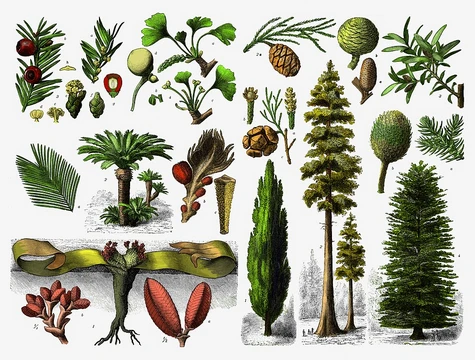
Picea abies
A widely planted spruce native to Europe.

Picea abies, the Norway spruce or European spruce, is a species of spruce native to Northern, Central and Eastern Europe. It is a large, fast-growing evergreen coniferous tree, widely planted for its wood and as a Christmas tree.
- species
- Picea abies
- common_names
- Norway spruce, European spruce
- native_range
- Northern, Central and Eastern Europe
- cone_length
- 9–17 cm
- first_gymnosperm_genome_sequenced
- True
Lore & Background
The Norway spruce grows throughout Europe from Norway in the northwest and Poland eastward, and also in the mountains of central Europe, southwest to the western end of the Alps, and southeast in the Carpathians and Balkans to the extreme north of Greece. Its eastern limit in Russia is hard to define owing to extensive hybridisation and intergradation with the Siberian spruce (Picea obovata), but is usually given as the Ural Mountains. The hybrid is known as Picea × fennica. Populations in southeast Europe tend to have on average longer cones with more pointed scales, sometimes distinguished as Picea abies var. acuminata.
Reader's Guide
The Norway spruce is one of the most widely planted spruces, both in and outside of its native range, and one of the most economically important coniferous species in Europe. It is used as an ornamental tree in parks and gardens, and widely planted for use as a Christmas tree. Every year the Norwegian capital city, Oslo, provides the cities of London, Edinburgh and Washington, D.C. with a Norway spruce, placed in the central square of each city, mainly in gratitude for aid during the Second World War. In North America it is widely planted in the Northeastern, Pacific Coast, and Rocky Mountain states, as well as in southeastern Canada, and is naturalised in some parts. It is used in forestry for softwood timber and paper production. The Norwegian company Borregaard produces a synthetic substitute for natural vanilla, vanillin, using the Norwegian spruce. It is esteemed as a source of tonewood by stringed-instrument makers, and one form called Haselfichte (Hazel-spruce) was used by Stradivarius for instruments. The tree is the source of spruce beer, once used to prevent and even cure scurvy. Norway spruce shoot tips have been used in traditional Austrian and Finnish medicine. The resin has been used in Nordic folk medicine for treating wounds and skin disorders.
Did You Know?
- The Norway spruce is used to produce a synthetic substitute for natural vanilla, vanillin.
Architecture and Growth
The Norway spruce is a commanding evergreen conifer reaching 35 to 55 metres in height, with a trunk one to one and a half metres across. In its youth, under favourable conditions, it can add a full metre of height each year for the first twenty-five years, though growth noticeably decelerates once the tree surpasses twenty metres. Its branchlets characteristically droop, lending the crown a distinctive silhouette. The foliage comprises blunt-tipped, needle-like leaves measuring 12 to 14 millimetres, quadrangular in cross-section and uniformly dark green on all four faces. Perhaps its most striking reproductive feature is the seed cone, ranging from 9 to 17 centimetres—the longest produced by any spruce. These cones begin green or reddish and ripen to brown roughly five to seven months after pollination, bearing black seeds each fitted with a pale brown wing of about 15 millimetres. The tallest verified specimen stands at 62.26 metres near Ribnica na Pohorju in Slovenia. In its native European range the tree can live up to three hundred years, with seed production commencing in its fourth decade, though its crown gradually thins and lower limbs die back with advancing age.
Range and Ecological Niche
Native to northern, central, and eastern Europe, the Norway spruce stretches from Norway in the northwest and Poland eastward, threading through the mountains of central Europe. Its range extends southwest to the western Alps and southeast through the Carpathians and Balkans to the extreme north of Greece. The northern boundary pushes into the Arctic, just beyond 70° N in Norway. The eastern limit in Russia is difficult to pin down because of extensive hybridisation with the Siberian spruce, though it is generally placed at the Ural Mountains. Trees displaying Siberian characters appear as far west as much of northern Finland, with a handful of records in northeast Norway. The resulting hybrid, known as Picea × fennica, is set apart by a tendency toward hairy shoots and cones bearing smoothly rounded scales. In the wild, the cone scales serve as food for caterpillars of the tortrix moth Cydia illutana, while the related Cydia duplicana feeds on bark around wounds and cankers. Populations in southeastern Europe tend to produce longer cones with more pointed scales, a variation sometimes recognised as Picea abies var. acuminata, though overlap with other populations is extensive.
Cultural Presence and Global Cultivation
Among the most widely planted conifers on Earth, the Norway spruce holds a position of both economic and cultural prominence. It ranks among the most economically important coniferous species in Europe, valued for its timber and as an ornamental in parks and gardens. Its most visible cultural role is as the Christmas tree of choice in several countries. Each year, Oslo sends a Norway spruce to Trafalgar Square in London, to Edinburgh, and to Washington, D.C., a gesture of gratitude for the aid those nations provided during the Second World War. In North America the species is widely planted across the Northeastern, Pacific Coast, and Rocky Mountain states as well as southeastern Canada, and it has become naturalised from Connecticut to Michigan. The tree thrives in cool-summer climates, tolerating USDA Growing Zone 7 and, along the west coast where summers remain mild, even parts of Zone 10. It handles acidic soils well but struggles in dry or nutrient-poor ground. In the northern United States and Canada it is occasionally reported as invasive, though in Zone 6 and above, hot humid summers significantly reduce seed germination and limit its spread. It was the first gymnosperm to have its genome sequenced.
Taxonomic Neighbours and Cultivar Diversity
The Norway spruce sits at the centre of a web of close relatives and hybrids that complicates its taxonomy. The Siberian spruce (Picea obovata), which replaces it east of the Urals, is so genetically similar that some botanists treat it as merely a subspecies. In its typical form, however, the Siberian spruce is quite distinct, bearing shorter cones of 5 to 10 centimetres with smoothly rounded scales and pubescent shoots. A rarer form occurring in the Central Alps of eastern Switzerland—sometimes called Alpine spruce (Picea alpestris)—also shows rounded cone scales and hairy shoots, but adds thicker, blue-green foliage. Genetic evidence links this alpine form more closely to Siberian, Schrenk's, and Morinda spruces than to the Norway spruce itself, yet it hybridises so extensively with Picea abies that pure specimens are rare. The resulting hybrids are commonly (and confusingly) called "Norwegian spruce." Beyond wild taxa, horticulturists have selected numerous cultivars—'Barrya', 'Capitata', 'Decumbens', 'Dumosa', 'Inversa', 'Repens', 'Virgata', and others—spanning full-sized forest trees to extremely slow-growing prostrate forms. Several, including 'Acrocona', 'Clanbrassiliana', and 'Inversa', have earned the Royal Horticultural Society's Award of Garden Merit. The Latin epithet abies simply means "like Abies, the fir tree."
Frequently Asked Questions
Who is Picea abies?
Picea abies, commonly called the Norway spruce or European spruce, is a large evergreen conifer native to Northern, Central, and Eastern Europe. It can grow to over 60 meters tall and is one of the most recognizable towering trees in European forests.
What are Picea abies's powers/role?
This fast-growing spruce produces wind-pollinated cones measuring 9 to 17 cm and yields highly valued timber for construction, paper, and furniture. It has also become the quintessential Christmas tree species across much of Europe and beyond.
Why is Picea abies important?
As one of Europe's most widely planted and economically significant trees, it underpins major forestry, timber, and paper industries across the continent. Its deep cultural role as the traditional Christmas tree gives it a place in European holiday traditions that few other species share.
Where does Picea abies call home?
Picea abies is native to the cool, moist forests of Northern, Central, and Eastern Europe, where it thrives at a range of elevations. It has since been introduced and cultivated in many other regions around the world for both timber and ornamental purposes.
More in Conifers And Gymnosperms 1-24
Elsewhere in the Conifers And Gymnosperms universe
Spotted an error? Know more?
This is a living reference — every entry is fact-audited, and reader corrections feed straight into our audit queue. Suggest an edit · See this site's audit record