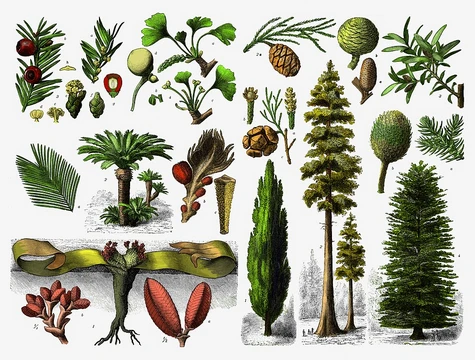
Pinus elliottii
Slash pine is a strong, fast-growing conifer of Southeastern US wetlands.

Pinus elliottii, commonly known as slash pine, is a conifer tree native to the coastal plain of the Southeastern United States. It is named after the 'slashes' – swampy ground overgrown with trees and bushes – that constitute its habitat. Historically, slash pine has been an important economic timber for naval stores, turpentine, and resin, and its wood is known for unusually high strength, especially for a pine.
- field
- Botany
- native_range
- Coastal plain of the Southeastern United States
- known_for
- Economic timber for naval stores, turpentine, and resin; high-strength wood
- varieties
- P. e. var. elliottii and P. e. var. densa
- max_height
- 18–30 m (59–98 ft)
Lore & Background
Slash pine is a fast-growing but not very long-lived pine, reaching heights of 18–30 m with a trunk diameter of 0.6–0.8 m. Its leaves are needle-like, in clusters of two or three, and 18–24 cm long. The cones are glossy red-brown, 5–15 cm in length, with a short, thick prickle on each scale. However, because its average density is less than half that of ironwood, slash pine has a far greater strength-to-weight ratio. Two varieties are described: P. e. var. elliottii (typical slash pine) ranges from South Carolina to Louisiana and south to central Florida, with leaves mostly in bundles of three and larger cones. P. e. var. densa (South Florida slash pine) is found in the pine rocklands of southern Florida and the Florida Keys, with leaves nearly all in bundles of two, smaller cones, denser wood, a thicker taproot, and a grass stage in seedlings. Recent genetic studies have indicated that the varieties may not be more closely related to each other than to other pines in the Southeast, which could warrant reclassification as separate species. Slash pine can hybridize with loblolly pine, sand pine, and longleaf pine.
Reader's Guide
Slash pine has been a significant economic timber species in the Southeastern United States, historically valued for naval stores, turpentine, and resin. Its wood's high strength-to-weight ratio makes it comparable to much denser woods, contributing to its commercial importance. The species is predominantly found in Florida and Georgia, extending from South Carolina to southeastern Louisiana and south to the Florida Keys, and is common in East Texas, where it was first planted at the E.O. Its natural habitat includes sandy subtropical maritime forests and wet flatwoods. Fire ecology has played a crucial role in slash pine forests. Native Americans historically burned land to improve grass growth and visibility for hunting. After European settlement, fire suppression became common, especially following the Smokey Bear campaign in the 1940s, leading to ecosystem changes such as conversion to mixed-hardwood canopies or rockland hammocks dominated by woody shrubs and invasive species. Controlled burning, which regained traction in the 1950s and 1960s, is used to manage invasive species, reduce pathogen loads, prevent fuel buildup, and maintain fire-dependent ecosystems. Prescribed burn intervals are typically every 2–5 years. Diseases and pests have also impacted slash pine. Starting in the late 1950s, fusiform rust, caused by the fungus Cronartium quercuum f. sp. fusiforme, led to massive tree mortality in the pine industry. This obligate parasitic pathogen has a complicated lifecycle requiring oak trees as a secondary host. Management strategies such as pruning diseased stems, reducing fertilization, and discarding infected seed were insufficient to prevent million-dollar annual losses.
Did You Know?
- Slash pine is named after the 'slashes' – swampy ground overgrown with trees and bushes – that constitute its habitat.
- P. e. var. densa has a 'grass stage' similar to longleaf pine and is not frost tolerant, limiting its range to South Florida.
- Slash pine can hybridize with loblolly pine, sand pine, and longleaf pine.
Frequently Asked Questions
What is Pinus elliottii?
Pinus elliottii is a fast-growing coniferous tree native to the coastal plains of the southeastern United States, most commonly called slash pine. It is well known among botanists and timber workers for producing wood that is unusually strong for a pine species.
Why is it called "slash pine"?
The common name refers to the "slashes"—dense, swampy thickets of trees and undergrowth—that make up the tree's typical habitat. In other words, the name describes the tangled wetland environment where the species thrives rather than any feature of the tree itself.
Where does slash pine naturally grow?
Its native range is limited to the coastal plain of the southeastern United States, where it favors wet, swampy ground. It is not found naturally outside this region.
What is slash pine historically used for?
For centuries it has been a key source of naval stores such as turpentine and resin, making it a major economic timber. Its wood is also prized in construction and lumber because it carries unusually high strength compared to other pines.
More in Conifers And Gymnosperms 1-24
Elsewhere in the Conifers And Gymnosperms universe
Spotted an error? Know more?
This is a living reference — every entry is fact-audited, and reader corrections feed straight into our audit queue. Suggest an edit · See this site's audit record