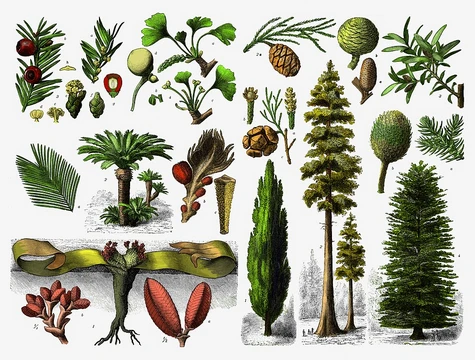
Pinaceae
A large conifer family of pines, firs, spruces, and cedars.

The pine family, Pinaceae, is a large group of conifers that includes many well-known, commercially valuable trees like cedars, firs, hemlocks, larches, pines, and spruces. It belongs to the order Pinales, once called Coniferales. The family is defined by its distinctive woody cones, which typically have two ovules per scale, and is considered monophyletic based on both physical traits and genetic data. With between 220 and 250 species across 11 genera (depending on the taxonomist), it is the most species-rich conifer family alive today. Geographically, it is the second-widest ranging conifer family (after Cupressaceae), found across most of the Northern Hemisphere. Most species thrive in temperate climates, but the family extends from subarctic to tropical regions. Pinaceae often dominates boreal, coastal, and montane forests. One species, *Pinus merkusii*, grows just south of the equator in Southeast Asia. Major centers of diversity are in the mountains of southwest China, Mexico, central Japan, and California.
Members of Pinaceae are trees (rarely shrubs), ranging from 2 to 100 meters tall. They are mostly evergreen—except for the deciduous larches (*Larix* and *Pseudolarix*)—resinous, and monoecious, with subopposite or whorled branches and spirally arranged, needle-like leaves. Their embryos have three to 24 cotyledons. Female cones are large and usually woody, 2 to 60 centimeters long, with numerous spirally arranged scales, each bearing two winged seeds. Male cones are small, 0.5 to 6 centimeters long, and fall off soon after releasing wind-dispersed pollen. Seed dispersal is mostly by wind, though some species have large seeds with reduced wings and are spread by birds. The size and function of Pinaceae cones have been shaped by selective pressure from different seed dispersal mechanisms. All species with seeds weighing less than 90 milligrams are adapted for wind dispersal. Pines with seeds over 100 milligrams are more likely to have evolved traits that promote animal dispersal, especially by birds. In areas where tree squirrels are abundant, Pinaceae species do not seem to have evolved adaptations for bird dispersal. Boreal conifers have several winter adaptations: a conical shape to shed snow, strong tracheid vessels to withstand ice pressure, and a waxy coating on needles to reduce water loss.
The Pinaceae lineage split from other conifers during the late Carboniferous, around 313 million years ago. Possible stem-group relatives appear as early as the Late Permian. The extinct cone genus *Schizolepidopsis* likely represents stem-group members, with the first clear records appearing in the Middle to Late Triassic and becoming abundant across Eurasia during the Jurassic. The oldest known crown-group member is the cone *Eathiestrobus*, from the Upper Jurassic of Scotland (about 157 to 155 million years ago), which likely belongs to the pinoid group. The family radiated rapidly during the Early Cretaceous, when modern genera like *Pinus* (pines), *Picea* (spruce), and *Cedrus* (cedar) first appear. The extinct Cretaceous genera *Pseudoaraucaria* and *Obirastrobus* appear to be members of the subfamily Abietoideae, while *Pityostrobus* is non-monophyletic, containing distantly related members of the family. Although Pinaceae and its two subfamilies existed well before the breakup of Pangaea, their distribution was limited to northern Laurasia. During the Cenozoic, Pinaceae experienced higher rates of species turnover than Southern Hemisphere conifers, likely driven by range shifts in response to glacial cycles.
Molecular studies show that Gnetophyta is the sister group to Pinaceae, with the two lineages diverging in the early to mid Carboniferous—a finding known as the "gnepine" hypothesis. The subfamilies Abietoideae and Pinoideae diverged in the Jurassic. Within these, the tribes Pineae and Lariceae split in the Late Jurassic, while Abieteae and Pseudolariceae diverged in the Cretaceous. A 2018 transcriptomic analysis divided Pinaceae into these two clades, now recognized as subfamilies. A 2013 study by Lockwood and colleagues produced a broadly similar phylogeny but placed *Pseudolarix* and *Cathaya* differently, subsuming Pseudolariceae within Abieteae.
Classification of Pinaceae subfamilies and genera has long been debated, drawing on ecology, morphology, and evolutionary history. In 1891, Van Tieghem divided the family into two subfamilies based on the number and position of resin canals in the young taproot. In 1910, Friedrich Vierhapper split it into two tribes based on the presence and type of long-shoot/short-shoot dimorphism. In 1976, Charles Miller used features of ovulate cone anatomy in both living and fossil members. For example, Price (1987) recognized 11 genera in four subfamilies, based on microscopic anatomy and the morphology of cones, pollen, wood, seeds, and leaves. In his scheme, subfamily Pinoideae (genus *Pinus*) has cones that are biennial (rarely triennial), with each year's scale growth distinct, forming an umbo on each scale, and a broad cone scale base that fully conceals the seeds.
- genera
- 11 genera
- geographical_range
- Most of the Northern Hemisphere, from subarctic to tropical
- major_centers_of_diversity
- Mountains of southwest China, Mexico, central Japan, and California
Lore & Background
The earliest good records of stem-group members appear in the Middle-Late Triassic, with abundant Jurassic fossils across Eurasia. The oldest crown-group member is the cone Eathiestrobus from the Upper Jurassic of Scotland. Modern genera such as Pinus, Picea, and Cedrus first appear in the Early Cretaceous. The family rapidly radiated during the Early Cretaceous, and its distribution was historically limited to northern Laurasia.
Reader's Guide
The Pinaceae are ecologically and economically significant as the dominant conifers in many boreal, coastal, and montane forests of the Northern Hemisphere. Their cones exhibit variation in size and function shaped by selective pressure from seed dispersal mechanisms: species with seeds under 90 milligrams are adapted for wind dispersal, while those with seeds over 100 milligrams often rely on animal dispersal, particularly by birds. The family's evolutionary history includes a rapid radiation in the Early Cretaceous and higher species turnover during the Cenozoic, driven by glacial cycles. Phylogenetic studies support the monophyly of Pinaceae and place Gnetophyta as their sister group. Taxonomic classification has evolved, with recent molecular analyses dividing the family into two subfamilies: Pinoideae and Abietoideae.
Did You Know?
- Pinaceae have distinctive cones with woody scales bearing typically two ovules.
- The family includes both evergreen species and deciduous ones (Larix and Pseudolarix).
- Boreal conifers have adaptations such as a conical shape to shed snow and waxy needle coverings to minimize water loss.
- One species, Pinus merkusii, grows just south of the equator in Southeast Asia.
Frequently Asked Questions
What are Pinaceae's powers and role?
As the dominant tree family across boreal, coastal, and montane forests, Pinaceae essentially builds the structural backbone of those ecosystems. Its members also supply a huge share of the world's timber, resin, and ornamental stock, making the family a linchpin of both ecology and industry.
Why is Pinaceae important?
Beyond sheer ecological dominance, Pinaceae harbours some of the richest conifer diversity hotspots on Earth, found in the mountains of southwest China, Mexico, central Japan, and California. That concentration of endemism makes the family a priority for conservation and a living archive of ancient forest evolution.
More in Conifers And Gymnosperms 1-24
Elsewhere in the Conifers And Gymnosperms universe
Spotted an error? Know more?
This is a living reference — every entry is fact-audited, and reader corrections feed straight into our audit queue. Suggest an edit · See this site's audit record