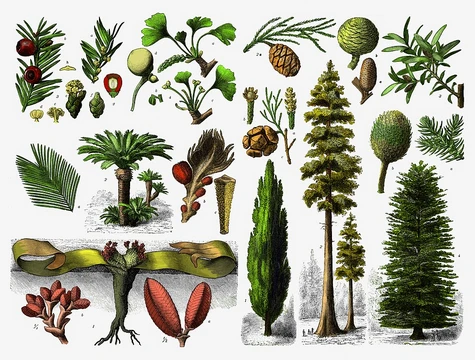
Podocarpaceae
A diverse family of southern hemisphere conifers with fleshy seed cones.

Podocarpaceae is a large family of mainly southern hemisphere conifers, known in English as podocarps, comprising about 201 species of evergreen trees and shrubs. It contains 20 genera if Phyllocladus is included and Manoao and Sundacarpus are accepted. The family achieved its maximum diversity in the Cenozoic, making the Podocarpaceae family one of the most diverse in the southern hemisphere.
- species_count
- about 201
- genera_count
- 20 (if Phyllocladus included, Manoao and Sundacarpus accepted)
- primary_region
- Southern Hemisphere
- centers_of_diversity
- Australasia, especially New Caledonia, Tasmania, New Zealand; also Malesia and South America (Andes)
- oldest_unambiguous_fossils
- Jurassic period
- unique_feature
- Parasitaxus usta is the only known parasitic gymnosperm
Lore & Background
The Podocarpaceae show great diversity, both morphologically and ecologically. Members occur mainly in the Southern Hemisphere, with most genetic variety taking place in New Caledonia, New Zealand, and Tasmania. Species diversity of Podocarpus is found mainly in South America and the Indonesian islands, the latter also being rich in Dacrydium and Dacrycarpus species. Podocarpus (with 82 to 100 species) and Dacrydium (with 21 species) are the largest genera. A few genera are common to New Zealand and South America, supporting the view that podocarps had an extensive distribution over southern Gondwanaland. The breaking up of Gondwanaland led to large-scale speciation of the Podocarpaceae. All four of the African species fell under Podocarpus. Taxonomists divided Podocarpus species into eight species groups based on leaf anatomy. Studies of embryology, gametophyte development, female cone structure, and cytology led to the belief that the eight categories probably deserved generic status. Researchers agreed on the need to recognize 'fairly natural groupings which prove to have good geographic and probably evolutionary cohesion' and took the necessary steps to raise each section to generic status. More recent treatments of the family have accepted both Manoao and Sundacarpus, resolving the monophyly of Prumnopitys with respect to Sundacarpus by splitting some species out into a new genus Pectinopitys.
Reader's Guide
The Podocarpaceae are significant as a classic member of the Antarctic flora, with their main centres of diversity in Australasia, particularly New Caledonia, Tasmania, and New Zealand, and to a slightly lesser extent Malesia and South America (primarily in the Andes Mountains). Several genera extend north of the equator into Indochina and the Philippines. Podocarpus reaches as far north as southern Japan and southern China in Asia, and Mexico in the Americas, and Nageia into southern China and southern India. Two genera also occur in sub-Saharan Africa, the widespread Podocarpus and the endemic Afrocarpus. The family's legacy includes the unique parasitic gymnosperm Parasitaxus usta, which occurs on New Caledonia, where it is parasitic on another member of the Podocarpaceae, Falcatifolium taxoides. Except for the two genera Pherosphaera and Saxegothaea, all members of Podocarpaceae have fleshy seed cones, which appears to be an ancestral trait. Molecular evidence supports Podocarpaceae being the sister group to the Araucariaceae, and having diverged from it during the late Permian. The oldest unambiguous members of the family are known from the Jurassic period, found across both hemispheres. Modern genera of the family first appeared during the Early Cretaceous, with the family probably reaching an apex of diversity during the early Cenozoic.
Did You Know?
- Parasitaxus usta is the only known parasitic gymnosperm, occurring on New Caledonia and parasitic on Falcatifolium taxoides.
- Except for Pherosphaera and Saxegothaea, all members of Podocarpaceae have fleshy seed cones, an ancestral trait.
- The genus Phyllocladus is sister to Podocarpaceae sensu stricto and is treated by some botanists in its own family, the Phyllocladaceae.
- Molecular evidence supports Podocarpaceae being the sister group to the Araucariaceae, diverging during the late Permian.
More in Conifers And Gymnosperms 1-24
Elsewhere in the Conifers And Gymnosperms universe
Spotted an error? Know more?
This is a living reference — every entry is fact-audited, and reader corrections feed straight into our audit queue. Suggest an edit · See this site's audit record