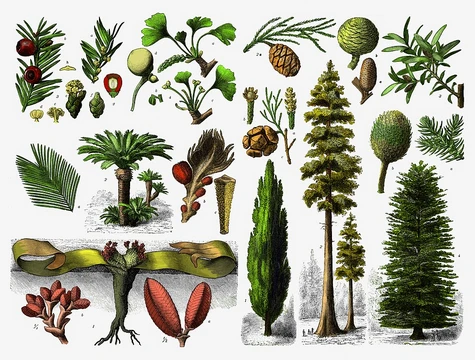
Pinus lambertiana
Tallest and most massive pine, with among the longest cones.

Pinus lambertiana, commonly known as the sugar pine, is the tallest and most massive pine tree species. It is native to coastal and inland mountain areas along the Pacific coast of North America, from Oregon south to Baja California in Mexico. The species is notable for its great height, large cones, and sweet resin, which gave it its common name.
- scientific_name
- Pinus lambertiana
- common_name
- Sugar pine
- cone_length
- 10–50 cm (4–20 in), occasionally up to 56 cm (22 in)
- native_range
- Oregon to Baja California, in Cascade Range, Sierra Nevada, Coast Ranges, and Sierra San Pedro Martir
- genome_size
- 31 gigabases
Lore & Background
Naturalist John Muir considered it the 'king of the conifers.' The common name comes from the sweet resin, which Native Americans used as a sweetener; John Muir found it preferable to maple sugar. The species has among the longest cones of any conifer, mostly 10–50 cm (4–20 in) long, though they can reach 56 cm (22 in). The unripe cones weigh 1–2 kg (2.2–4.4 lb) and can become perilous projectiles when chewed off by squirrels.
Reader's Guide
Pinus lambertiana is ecologically and historically significant as the tallest and most massive pine species, with a genome of 31 gigabases—one of the largest sequenced and assembled. Climate change poses additional threats by weakening tree defenses and increasing pest survival. The species never grows in pure stands and is shade tolerant in youth. Its seeds are eaten by yellow pine chipmunks, Steller's jays, and black bears. Native Americans ate the seeds raw or roasted, made flour from them, and consumed the sweet sap in small quantities. The species' decline due to multiple threats underscores the need for ongoing restoration.
Did You Know?
- The sugar pine's genome is 31 gigabases, one of the largest sequenced and assembled.
- The unripe cones weigh 1–2 kg (2.2–4.4 lb) and can become perilous projectiles when chewed off by squirrels.
- Native Americans used the sweet resin as a sweetener, and John Muir found it preferable to maple sugar.
Frequently Asked Questions
Who is Pinus lambertiana?
Pinus lambertiana, widely known as the sugar pine, is a conifer in the genus Pinus that holds the record as the tallest and most massive pine species on Earth, reaching roughly 83 meters. It earned its common name from the sweet, edible resin it exudes.
What are Pinus lambertiana's powers/role?
The sugar pine produces the longest cones of any pine, typically 10 to 50 centimeters and occasionally up to 56 centimeters. Its extraordinary girth and height make it the dominant canopy tree in its forests, while its sweet resin historically served as a food source for Indigenous peoples.
Where does Pinus lambertiana live?
This species is native to Pacific coastal and inland mountain forests, ranging from Oregon southward to Baja California, Mexico. It occupies the Cascade Range, Sierra Nevada, Coast Ranges, and the Sierra San Pedro Mártir.
How does Pinus lambertiana's story end?
As a long-lived conifer, the sugar pine completes its lifecycle through successive generations, with seedlings establishing in the same mountain forests where parent trees have stood for centuries. Its future is increasingly stressed by climate-driven drought and bark beetle outbreaks that weaken mature individuals across its range.
Why is Pinus lambertiana important?
The sugar pine is a keystone species in Pacific Northwest and California forests, providing structural diversity and habitat for countless other organisms. Its remarkably large genome of roughly 31 gigabases also makes it a focal point in plant-genetics research, and its sweet resin remains a culturally significant traditional food resource.
More in Conifers And Gymnosperms 1-24
Elsewhere in the Conifers And Gymnosperms universe
Spotted an error? Know more?
This is a living reference — every entry is fact-audited, and reader corrections feed straight into our audit queue. Suggest an edit · See this site's audit record